Teachers Share Their Experience with GDevelop for Education

Marcos Codas
Posted
We've been reaching out to teachers who use GDevelop for Education to ask them about their experience: how they use it, what their students think, and what results they've seen. The responses have been fantastic, and we wanted to share some of the highlights with you.
One thing that keeps coming up is how teachers are finding GDevelop through each other. Dustin DeGeorge, a Computer Science CTE instructor at Marcola School District in Oregon, told us he chose GDevelop over GameMaker 2 specifically because a colleague recommended it as more user-friendly for new students. That kind of word-of-mouth says a lot. When teachers are recommending a tool to other teachers, it means it's actually working in the classroom.
Whether you're a teacher thinking about bringing game development into your classroom, or you're just curious about how GDevelop is being used in schools around the world, read on.

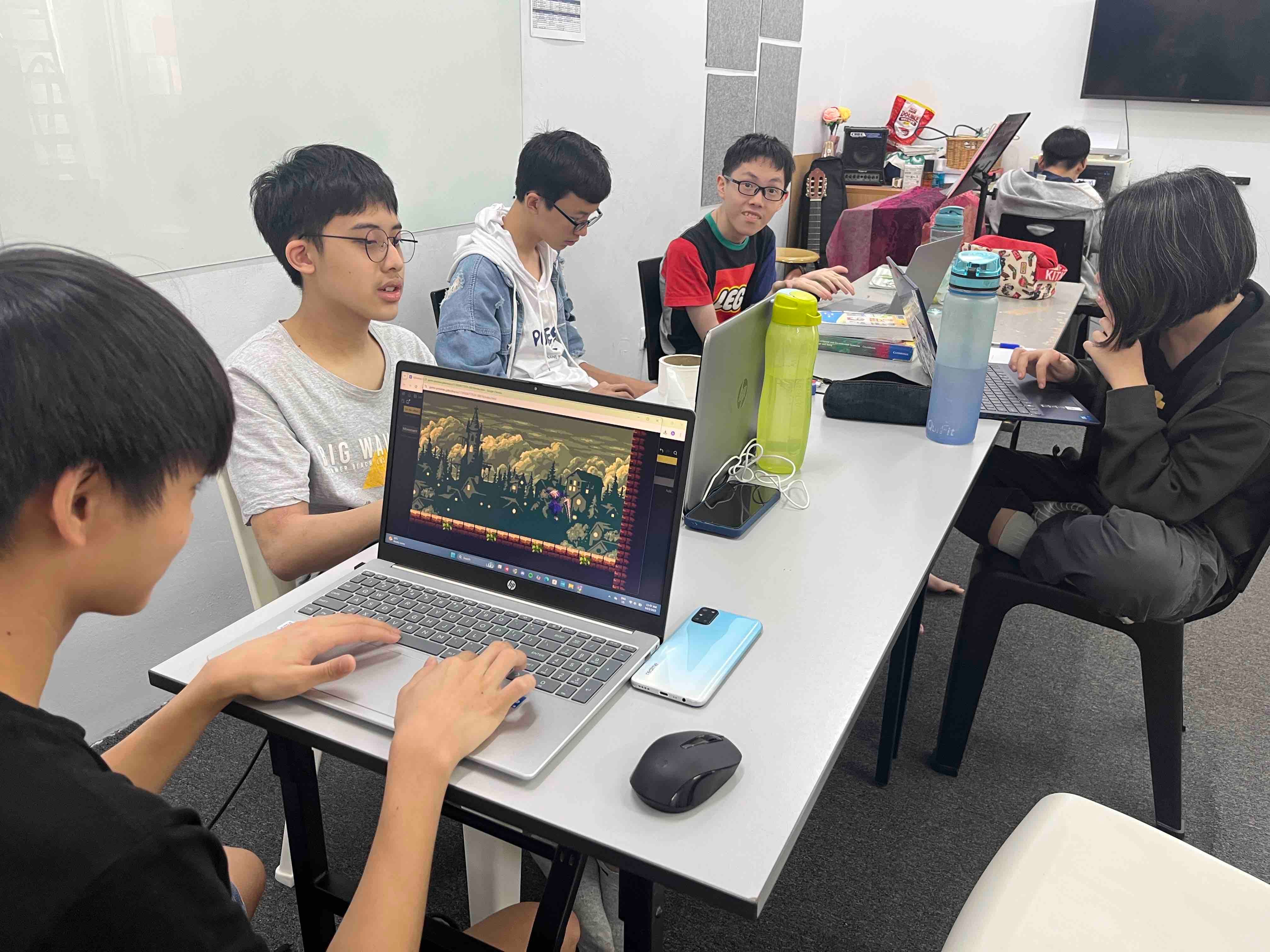
Deborah's students making games on GDevelop.
Moving Away from Unity in High School
Mark Young teaches at Webster Groves High School in Webster Groves, MO, where he runs a year-long Game Design program with 21 students aged 14 to 18. After more than a decade of teaching game design with Unity, he made the switch to GDevelop.
The reason was straightforward: Unity was a tough on-ramp.
"Our students often came to us with little to no programming experience and shared with me that it was quite challenging for them to enter straight into a world of object-oriented programming along with learning a new game development platform."
With GDevelop, students spend the semester building a 2D game from scratch, learning conditions, actions, art, audio, and game design principles. By the end, they have a complete project and a real understanding of what goes into making a game.
His students have been enthusiastic. One of the biggest wins? No installs. No Git. No cloud sync headaches.
"Students have been really happy with the fact that they do not have to install software and that they can resume work on their projects from any device just by opening up a browser and logging in."
Students also found GDevelop more capable than it first appeared: "They were quite surprised how complex GDevelop is because it initially looked simplistic to them... but they quickly discovered all of the conditions and multitude of actions available." Even working without code, they felt like real game developers.
Supporting Self-Paced Learning
Ryan Schmit, a Computer Programming teacher at Ironwood High School, uses GDevelop with students who are returning to the engine after months or even years away. Because everyone comes back at a different level, he lets students self-pace through tutorials. The detailed written instruction materials make that possible.
His students' words sum it up well:
"I honestly forgot a lot. I'd say I forgot most of GDevelop, and without the very detailed tutorial I would not have been able to do much of anything."
"I completely forgot most of the game production process, but I mainly struggled with sprite work, hitboxes, and design. Simple trial and error allowed me to tap into my past knowledge, but the detailed explanations in the instruction PDF file also helped a ton."
This kind of setup, where students can pick up where they left off without the teacher holding their hand through every step, is exactly what GDevelop for Education is designed to support. The built-in curriculum and project visibility tools mean teachers can check in on student progress without micromanaging it.
From Scratch to Something More
One of the most common stories we hear is teachers moving their students beyond Scratch. Scratch is a great entry point, but at some point students hit a ceiling. That's where GDevelop comes in.
Deborah Khoo, a teacher at a childcare centre in Penang, Malaysia, working with students aged 7 to 17, shared exactly this experience. After years of using Scratch for older kids, one of her students who was taking external computer classes introduced the group to GDevelop:
"It seemed like a great way for my students to expand their game creation, plus a fun way to introduce to the kids with no coding experience."
Students quickly agreed. In their own words: "GDevelop is very beginner-friendly, and it lets you make games without needing to learn complicated coding." And perhaps most tellingly: "GDevelop is my favorite coding engine, because it's not only simple to understand, but it really helps me be more creative when making these games."
The results speak for themselves. Deborah's group entered teams into GDevelop's own BIG Game Jams (#7 and #8), where they shipped four complete games: OP Rising, Dimenshift, Ghost Binding, and Friendly Edge. For students who had only recently moved on from Scratch, that's a remarkable achievement.


Students from Michael Wilder's class in Switzerland.
Reaching Students Who Need It Most
What strikes us most about these testimonials is the range of students being reached. We're talking about students with learning disabilities, kids in rural school districts, teenagers in Malaysia who had never heard of GDevelop six months ago.
Deborah summed up the broader goal beautifully:
"We also work with some students that have learning disabilities. By introducing tools like GDevelop, we hope that they will be able to develop skills that will be able to help them after they leave the school environment, whether it is teaching, creating more of their own projects or getting a job in a game development field."
That's what GDevelop for Education is really about. Not just making games, but building skills, confidence, and futures.
GDevelop for Education overview
GDevelop for Education gives teachers access to a managed classroom experience, with a built-in curriculum, teacher dashboard, and the ability to view and manage student projects. Students work in the browser with no downloads or installations required, which makes it practical in almost any school environment, including those with Chromebooks.
You can learn more at gdevelop.io/education, and if you're looking to get started with the platform, the teacher guide on our wiki is a great first stop.
Are you a teacher using GDevelop with your students? We'd love to hear your story. Feel free to reach out, and maybe your class will be featured in the next roundup!